


 51877
51877As a tradition of Carbonstop, on the first day back to work after every Spring Festival, we bring you an annual opening article. I hope it is neither an industry report, nor a corporate annual report, nor marketing material; it is more like a periodic record of reflections. Its significance lies in: recording the industry’s temperature, testing our own judgments, and publicly expressing our long-term choices.
Looking back years from now, these annual opening articles from Carbonstop may become some imprints and trajectories of the carbon neutrality industry's development, and if lucky, leave behind some intellectual assets.
From 2020 to 2025, carbon neutrality has experienced: the Policy Declaration Stage (2020), the Capital Fever Stage (2021), the Market De-bubbling Stage (2023), and the Industry Divergence Stage (2025). And now, we are entering: the Infrastructure Construction Stage (2026).

2025 Carbon Neutralization in Review
For carbon neutrality, 2025 was not the loudest year, but it may have been the most critical. We have the following observations:
1. 2025 is a Pivotal Year for the Global Carbon Neutrality
In the 2025 annual opening article, I mentioned that 2025 would be the global watershed for carbon neutrality; looking back now, this has indeed proven true.
Despite the impact of negative news such as the U.S. withdrawal from the Paris Agreement, China officially updated its Nationally Determined Contributions (NDC) targets as scheduled on September 24, 2025. By proposing absolute carbon reduction targets for 2035 (stating that carbon emissions in 2035 will decrease by 7%-10% from the peak), China has injected strong momentum into the global climate action process and set clear, mandatory emission reduction constraints for various industries.
ESG disclosure rules from the HKEX and the three major domestic exchanges (Shanghai, Shenzhen, and Beijing) have been fully implemented. Since January 1, 2025, large listed companies are required to disclose Scope 1 and 2 greenhouse gas emissions, while Scope 3 emissions have entered the "comply or explain" stage (with mandatory disclosure beginning in the 2026 fiscal year). Corporate carbon information disclosure has shifted from "optional" to "mandatory," with significantly higher requirements for data authenticity and granularity.
As a professional institution in the field of carbon management, Carbonstop closely tracks, participates in, and shares the dynamics and progress of global carbon neutrality. From June 2025 to February 2026, Carbonstop hosted four high-specification professional conferences in the carbon management sector: the CDP & Science-Based Carbon Management China Roadshow (Shanghai), the 2025 GCMC · China Carbon Management Forum (Beijing), the 2025 GCMC · Global Supply Chain Carbon Management Summit (Shenzhen), and the 2026 Zero Carbon Future Conference (Beijing). These conferences progressed systematically—covering environmental information disclosure, intelligent carbon management technologies, supply chain carbon management, and full-industry-chain zero-carbon transformation—consistently focusing on cutting-edge global trends, technological innovation, and industrial practice. Through these four conferences, we also felt the industry’s "temperature" and progress more profoundly. Hundreds of leading companies and institutions in the carbon management sector joined the exchange, making the steps toward achieving carbon neutrality even more resolute.
2. Carbon Management Enters the Second Half: Professionalism Wins, and "Pseudo-Low-Carbon" Enterprises Accelerate Exit
With tightening regulations and maturing markets, the carbon neutrality industry will undergo a profound reshuffle. Those "pseudo-low-carbon" enterprises that lack core technology and rely solely on speculating on policy dividends will be phased out by the market for failing to provide real value.
Conversely, enterprises with core competitiveness—carbon management service providers with authoritative data resources, R&D firms possessing key low-carbon technologies, and platform-based enterprises with comprehensive carbon-neutral solutions—will occupy a dominant market position.
The core of this differentiation lies in "Professionalism": the accuracy of carbon accounting, the feasibility of emission reduction plans, the ability to align with international standards, and the level of data security will become the core indicators of corporate competitiveness. A crucial feature of carbon management entering the second half is the shift from compliance to value creation. On July 25, 2025, the GCMC China Carbon Management Forum hosted by Carbonstop received significant attention from the industry and society. At the conference, I shared several important topics for the "second half" of corporate carbon management: Scope 3, the MERIT methodology for supply chain carbon management [with Carbonstop's 2025 projects empowering hundreds of suppliers for groups such as L'Oréal, Anta, and TCC serving as the practical foundation for this methodology], and high-quality carbon credits (CCT) [which was highly praised by Professor Myles Allen, the pioneer of the Net Zero concept at Oxford University, as "the core bridge connecting innovative carbon projects with green finance"].
3. Product Carbon Footprint (PCF) as the Core Driver of Carbon Management
In 2025, Product Carbon Footprint (PCF) entered a true "period of robust development" across the government, corporate, and consumer sectors. From power batteries to electronic products, and from national carbon labeling pilots to cross-border e-commerce, product carbon data is becoming the universal language of communication for governments, corporate brands, consumers, and supply chains.
- Governments use PCF for industrial management and structural optimization;
- Brands use product carbon data to tell sustainability stories and build differentiated competitiveness;
- Consumers understand the environmental responsibility behind products through carbon labels;
- Supply chains use carbon data for collaboration, screening, and optimization.
The advancement of PCF is inseparable from the construction of databases, which has been a topic of great concern in China in recent years. At the national level, the government is leading the construction of a national carbon footprint database; industry associations are building sectoral databases; local governments at all levels are establishing regional databases; and universities and third-party carbon service companies are creating their own PCF databases through both open-source and closed-source methods. This is a flourishing state. We believe that through the joint efforts of all stakeholders, China can quickly catch up with the global progress of carbon footprint database construction and play a more significant role in the global carbon neutrality field.
I have encountered many companies that are also establishing their own carbon databases. Here is a reminder: unless a company's data is exceptionally representative of the industry and has diverse application scenarios, it is rarely worth the investment. Building a carbon database is a highly capital-intensive undertaking, and securing high-quality data is even more challenging. The ROI will likely not be ideal; do not be misled or veer off course.
4. AI Fully Integrates into the Carbon Management Field
AI has been our most discussed societal theme in recent years. In 2023 and 2024, AI's role within vertical industries was limited to specialized Q&A bots. At that time, our position was that through pre-training and fine-tuning with high-quality industry data, we could produce superior results compared to ChatGPT or DeepSeek (for instance, providing more accurate answers for the 15 categories of Scope 3 or more appropriate emission factor retrieval during carbon accounting). However, by 2025, with the arrival of the AI Agent era, we have clearly seen AI being widely applied to core carbon management business processes, including:
- Automated Data Collection (e.g., using AI to transform unstructured data into standardized formats readable by systems)
- Model Calculation Optimization (e.g., intelligent error correction of activity data and automated matching of emission factors)
- Intelligent Reporting and Pre-assessment (e.g., automated generation of CDP questionnaires and ESG reports, along with pre-ratings and targeted improvement recommendations)
An Agentic carbon management model is taking shape. At the Zero-Carbon Future Conference held in Yizhuang on February 4th of this year, I shared a presentation titled "Carbon Management Paradigms in the AI Era," in which I offered a specific vision for Carbon Management Agents: "In the future, a company may not necessarily need a large staff for ESG or carbon management. Instead, it will require a multitude of ESG and carbon management Agents, each executing specific tasks. Managers will lead these Agents to complete various work objectives, and this likely represents the new paradigm for corporate carbon and ESG management."
On July 25, 2025, at the GCMC China Carbon Management Forum, Carbonstop officially released its epoch-making intelligent product: China's first carbon AI agent, Carbon AI Agent. At the Yizhuang Zero-Carbon Future Conference on February 4, 2026, Carbonstop further upgraded Carbon AI Agent by launching the lightweight Product Carbon Footprint AI Agent and the lightweight Corporate Carbon Accounting AI Agent. On Carbonstop's official website (accessible via web at https://www.carbonstop.com), users can now initiate product carbon footprint modeling and calculation through a single command. Furthermore, via Carbon Cloud, users can connect with leading global third-party certification bodies (such as SGS, CEC, etc.) to complete online certification, significantly reducing both the time and financial costs of carbon footprint calculation and certification.

5. Iteration of Drivers for Corporate Carbon Management: Consumers and Employees as Core Incremental Forces; The Arrival of the "People-Driven" Carbon Neutral Era
Whenever I lecture for the SynTao Academy—and I’d like to give a special nod to the academy founded by Mr. Guo Peiyuan in 2015; as an MBA-style program focused on ESG and carbon management, successfully running for ten years is no small feat—I conduct a small survey on the priority of core drivers for corporate carbon management. While customers, policies, and investors consistently rank in the top three, we are seeing a very different shift in drivers related to "people": consumers and employees. Although their ranking remains lower for now, the changes are significant.
After years of market education, consumer awareness of low-carbon living is gradually awakening, and 2026 will officially become one of the core drivers of carbon neutrality for Chinese enterprises. On one hand, the number of Amazon Climate Pledge Friendly (CPF) labels has exceeded 2.2 million, making carbon labels an "invisible threshold" for product listings. E-commerce platforms and major supermarkets have begun prioritizing products with transparent carbon footprints, forcing manufacturers to accelerate their low-carbon transformation. On the other hand, the younger generation of consumers has integrated "brand carbon responsibility" into their core purchasing decisions, and the market premium for carbon-neutral products is beginning to manifest.
At the same time, employee demands regarding corporate carbon neutrality have shifted from "observation" to "participation." Top talent now views a company's carbon-neutral practices as a critical factor when seeking employment. Within organizations, the implementation of employee carbon accounts and low-carbon office scenarios has become a key element of corporate culture and talent retention. Carbonstop's "TAG-Trash Remolding Program," launched in 2025, verified the practical value of employee-driven action by reducing office emissions and boosting team cohesion through DIY upcycling activities. Furthermore, every candidate who interviews at Carbonstop receives a special gift—a carbon-neutral pen; we build low-carbon identity and attraction starting from every detail.
We call for the swift arrival of the "people-driven" carbon-neutral era and eagerly await the "GPT moment" for carbon neutrality on the consumer side!

Trend Analysis for Carbon Neutrality in 2026
First and foremost, 2026 is destined to be a pivotal year for carbon neutrality. It marks the commencement of the "15th Five-Year Plan" and the inaugural year of the comprehensive transition from "Dual Control of Energy Consumption" to "Dual Control of Carbon Emissions." I believe 2026 will be defined by the following trends:
Trend 1: AI Will Completely Restructure the Carbon Management Industry Paradigm
In 2025, we witnessed AI Agents penetrating deep into the carbon management sector, which is now undergoing a "Productivity Leap." I have summarized four developmental stages of the carbon management industry: Consulting-driven → Software-driven → Data-driven → AI-driven.
In the past, carbon management relied heavily on expert experience and manual accounting. Today, rules can be coded, models can be trained, and data can be processed automatically. The emergence of AI is altering the industry's cost, efficiency, and scale structures. Carbon management will cease to be merely a reporting service and instead evolve into an algorithmic service.
How fast will this change occur? I believe AI’s disruption of the carbon management business will be faster, faster, and much faster than imagined!
Without investigation, there is no right to speak. In the AI era, without practice, there is no right to speak! Only by immersing oneself personally can one truly appreciate the magnitude of AI’s disruptive power.
During a few quiet days before the New Year, I set up the local environment for Carbonstop’s core platform, Carbon Cloud. (Setting up the environment was particularly time-consuming, taking about half a day in total, but it was a once-and-for-all effort. This was the first time in nine years I set up a development environment—2026, let’s get to work!) Around the Spring Festival, I used Cursor (an AI coding tool) to develop several features for Carbon Cloud. For instance, we are currently promoting a core feature: implementing online Excel editing within Carbon Cloud with flexible switching and data linkage between forms. This provides the most convenient functionality for future corporate data collection to be read by AI and systems for automated carbon accounting. Before the New Year, we estimated that traditional development would take at least several weeks. However, by using Cursor to input a few natural language commands (for example, I entered: "Can you help implement an online Excel editing function? Put this form content into an online Excel sheet"), basic realization of most desired functions was achieved in less than ten minutes with 2,500 lines of code. I found this absolutely staggering!

The following expected results were immediately achieved on Ccloud:
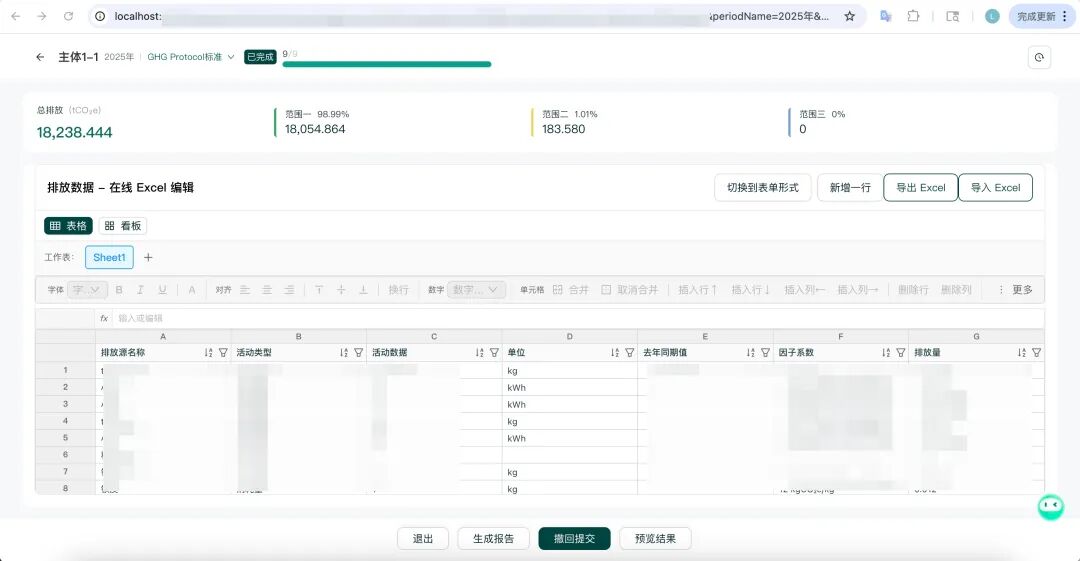
The remarkable power of AI programming tools like Cursor lies in the fact that they don’t just write code; they can also automatically download, debug, and run plugins and related dependencies based on your needs (the user only needs to click Fetch/Run, and everything is completed in the background). AI is no longer just a tool—it is delivering results. This is the true revolution!
Having not written code for nine years, it would typically take considerable time to re-familiarize myself with front-end and back-end syntax. However, with AI, I only need to describe the objective, the desired effect, and the logic, and almost everything can be achieved; everything is under control. I previously worried that AI coding platforms like Cursor would only be friendly to "greenfield" projects (like building a small Monopoly game from scratch) and would struggle with modifications to existing projects. But practice brings true knowledge: it can read the context of an existing project perfectly, providing timely feedback and adjustments to achieve the best results.
This is no longer a matter of improving efficiency by a certain percentage; it is a reconstruction of the entire work paradigm. In the past, every project required the deep involvement of multiple roles: product/project managers, UI designers, front-end and back-end developers, testers, and O&M engineers. Today, carbon consultants, product managers, or developers who understand the business can complete full-stack development incredibly fast. Time-to-market and development costs have dropped exponentially.
Returning to our industry, Carbon Cloud aims to become the "Agent" for corporate carbon management. Much like Cursor, it helps Carbon/ESG heads complete the entire lifecycle efficiently, simply, in an orderly fashion, and instantaneously with a single click. Non-professionals will also be able to complete various tasks with ease. It is not merely a passive system for answering questions or executing isolated tasks, but a proactive and autonomous operator that can mobilize all capabilities and resources to do its utmost to deliver results for the user's goals. "In the future, a company may not necessarily need a large staff for ESG or carbon management. Instead, it will require a multitude of ESG and carbon management Agents, each executing specific tasks. Managers will lead these Agents to complete various work objectives, and this likely represents the new paradigm for corporate carbon and ESG management."
Is this a distant reality? In other industries, this has already become a reality. For example, the author below has built a "one-person company" model supported by 16 Agents—16 AI digital employees working 24/7! Meanwhile, he only needs to work one hour a day. I believe the carbon management industry is not far from this either, and Carbonstop will continue to play the role of industry innovator, driving the implementation of this transformation.
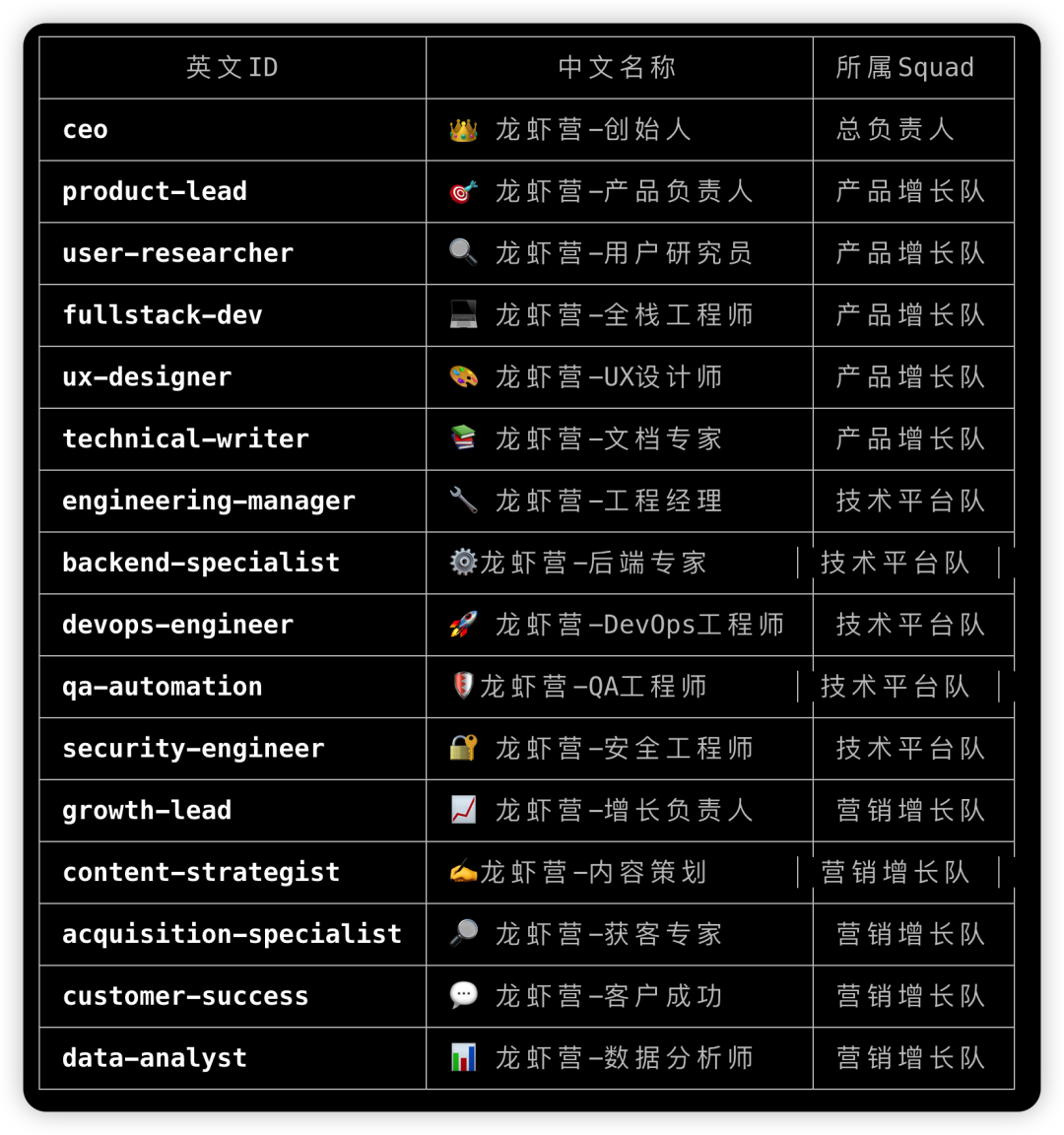
(source:https://mp.weixin.qq.com/s/MnVHvx1N497Bq0kz1fRc1w)
For various industries, including carbon service providers, the era of "human-wave" tactics is over. The size of a workforce is no longer a competitive advantage; instead, the future will be defined by Agent Density. Giants like Amazon, Microsoft, and Alibaba have recently seen their market caps soar despite massive layoffs. In an era where profit is king, capital markets have long viewed "revenue per employee" as the core metric for high-speed, sustainable development. Only those companies that truly embrace AI are worthy of saying they embrace the future.
The era of "one general leading a thousand troops" has arrived. My requirement for our R&D team is that by the first half of 2026, senior personnel must increase their efficiency by at least fivefold (equivalent to working alongside five Agents of equal capability); mid-level staff must lead at least three "clones" of themselves, and junior colleagues must lead at least two. Similar requirements will be set for other departments. In the AI era, one can no longer use "I'm too busy" as a mask for a lack of deep thinking. Failing to keep pace means certain obsolescence. This is no longer a stage for "saving for a rainy day" or generating unnecessary anxiety; we have entered the rescue phase. It is a matter of life and death.
A recent article from Huxiu noted that "every profession invented in the 20th century will struggle to escape the impact of AI." The more recent, the more "advanced," and the more abstract the mental skill—such as consulting, programming, accounting, or law—the sooner and more easily it will be uprooted by AI. Paradoxically, the oldest skills involving complex physical interaction in the real world (like haircutting, massage, plumbing, or even waitering) possess the deepest moats.
If AI is this powerful, what becomes of humans? With the aid of AI, humans can indeed save a vast amount of time to pursue more meaningful endeavors. AI frees us from the drudgery of simple tasks, allowing us to spend more time connecting with nature and experiencing life. It empowers us to tackle the "difficult but right" challenges that were previously out of reach—solving major diseases, addressing climate change, and other global issues that are profoundly challenging yet socially significant. Thanks to the support of AI, solving these problems has become more possible than ever before.
Trend 2: Product Carbon Footprint (PCF) as the "Language of Commodities"
Product Carbon Footprint has continued to gain momentum in recent years and is gradually becoming the "language of commodities." Driven by the continuous rise of international carbon compliance, the fact that carbon footprints have become the "entry ticket" for cross-border e-commerce (the number of Amazon Climate Pledge Friendly labels exceeded 2.2 million in 2024; PromoCollection, a cross-border gift e-commerce provider in countries like Australia, completed carbon footprint calculations for over 3,000 products in 2025 to display to customers), and the vigorous popularization of national carbon labeling, every product SKU will possess a string of carbon data in the future. This data may determine:
- Whether it enters a specific market
- Whether it obtains a certain certification
- Whether it commands a price premium
- Whether it receives priority display on platforms
Carbon footprint is transforming from an "environmental indicator" into a "commodity attribute." This is not idealism, but the evolution of rules.
Since I have discussed carbon footprint extensively before, I will not elaborate further here. Carbonstop’s mission is: "To make carbon footprint visible on every product." We eagerly look forward to the arrival of this day and will continue to devote ourselves wholeheartedly and spare no effort to achieve our mission!
Trend 3: Carbon Data as the Foundational Data Layer of Enterprises
Over the past few decades, corporate management has undergone several infrastructure upgrades:
- Financial Systems
- ERP Systems
- CRM Systems
Now, a new data layer is taking shape: The Carbon Data Layer.
In the coming years, carbon management systems will gradually become a standard requirement rather than an optional add-on for corporate management. Enterprises without carbon data capabilities will find themselves unable to:
- Participate in global supply chains
- Meet the disclosure requirements of financial institutions
- Navigate cross-border trade regulations
- Achieve realistic emission reduction pathway planning
Carbon data is becoming the new "management chassis" of the enterprise.
Trend 4: The Carbon Management Industry Enters the Stage of Platform Divergence
Looking at the carbon management industry as a whole, a clear divergence is beginning to emerge:
- One category of companies focuses on consulting and delivery;
- One category of companies focuses on SaaS tools;
- One category of companies focuses on the foundational data layer;
- A tiny minority of companies focus on "platform-level infrastructure."
Over the next three to five years, the industry will undergo a structural realignment. We anticipate that:
- A large number of project-based companies will be marginalized;
- Point-solution tool companies will be consolidated;
- Companies with fragmented data will face immense pressure regarding standardization;
- Only platform-based enterprises will be able to continuously accumulate value. (Carbon management is, in essence, a systems engineering task. It requires data integration, standardization, algorithmic optimization, API expansion, and ecological synergy. This is not a single-point capability, but a systemic one.)
In addition to the trends mentioned above, I believe the following shifts will emerge in 2026:
1. Enterprises Moving from "Commitment" to "Delivery"
- SBTi and "Dual Carbon" goals are no longer scarce;
- What is scarce is whether these goals reach Scope 3, and whether they integrate into business and investment decision-making;
- The market is beginning to ask: "How much have you reduced? At what cost? What was the impact?"
2. From "Calculating the Result" to "Calculating Accurately and Quickly"
- Carbon accounting is no longer about Excel spreadsheets and consulting reports;
- Enterprises are beginning to demand high-frequency, credible, and reusable accounting.
3. From "Point-Solution Reductions" to "Systemic Transformation"
- The marginal utility of isolated projects (such as solar PV or offsets) is declining;
- True value now lies in supply chain synergy, carbon competitiveness at the product level, and "carbon" becoming part of the operational language.

2026,Carbonstop’s Strategic Choices
Having started this entrepreneurial journey on March 3, 2011, Carbonstop is suddenly approaching its 15th anniversary. It is heartening to see that we remain that same "youthful" entity—dream-driven, evolving with the times, maintaining innovation, and always committed to doing the "difficult but right" things!
Carbonstop is dedicated to becoming a global infrastructure-level company for carbon management. In 2026, we proposed a new strategy: "Carbon Cloud as the cornerstone, professional services as the reach, and an ecological platform as the moat." We are sparing no effort to become a platform infrastructure enterprise. This includes establishing deep collaborations with key domestic and international carbon certification bodies (for certification, verification, and assurance), providing clients with emission reduction strategies and implementing reduction projects (through dozens of highly credible partners in green power, GECs, low-carbon packaging, low-carbon logistics, etc.), and supplying high-quality global carbon credits. In 2026, Carbonstop will focus its energy on building platform infrastructure to bolster the healthy and sustainable development of the entire industry!
Choosing to be the platform infrastructure means we will:
- Continuously build Carbon AI capabilities
- Deepen the CCDB carbon data foundation
- Construct a scalable Carbon Cloud platform
- Establish an ecosystem of APIs and interfaces
Building infrastructure isn't "sexy," but it holds long-term value.
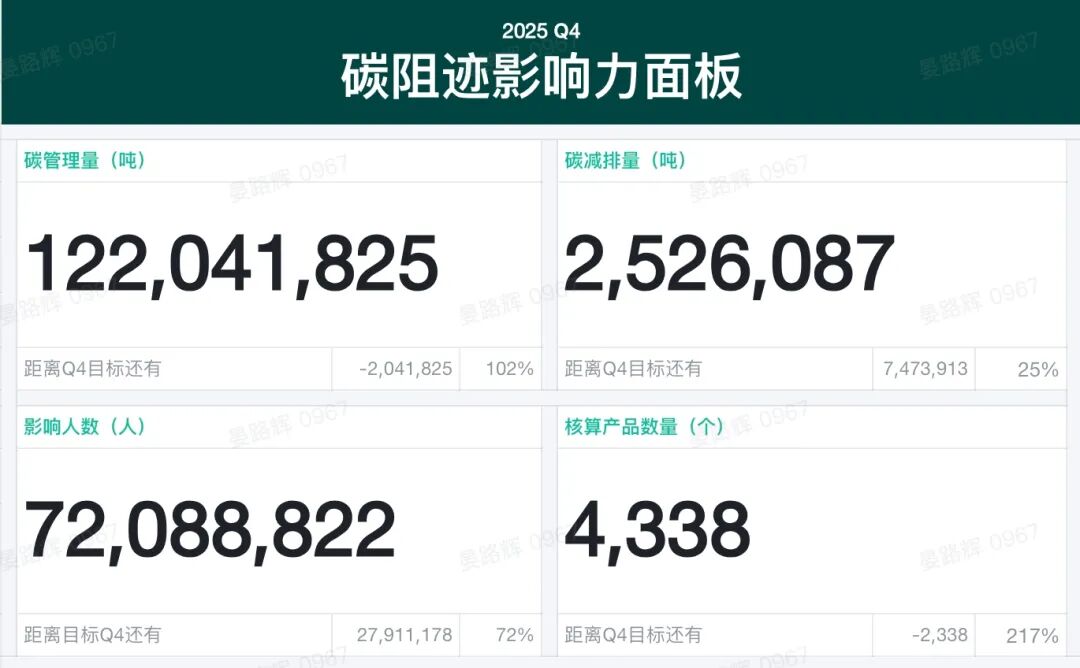
In 2026, we will continue to expand our social impact. In 2025, we embarked on a very meaningful initiative by launching our Social Impact Dashboard, which tracks data across several dimensions: total carbon managed, carbon emissions reduced, number of people influenced, and the quantity of products accounted for. Below is our latest performance data; achieving these results was incredibly challenging, yet immensely rewarding. In 2026, we will carry this legacy forward, continuing to deepen Carbonstop’s social impact and striving to become a truly respected enterprise.
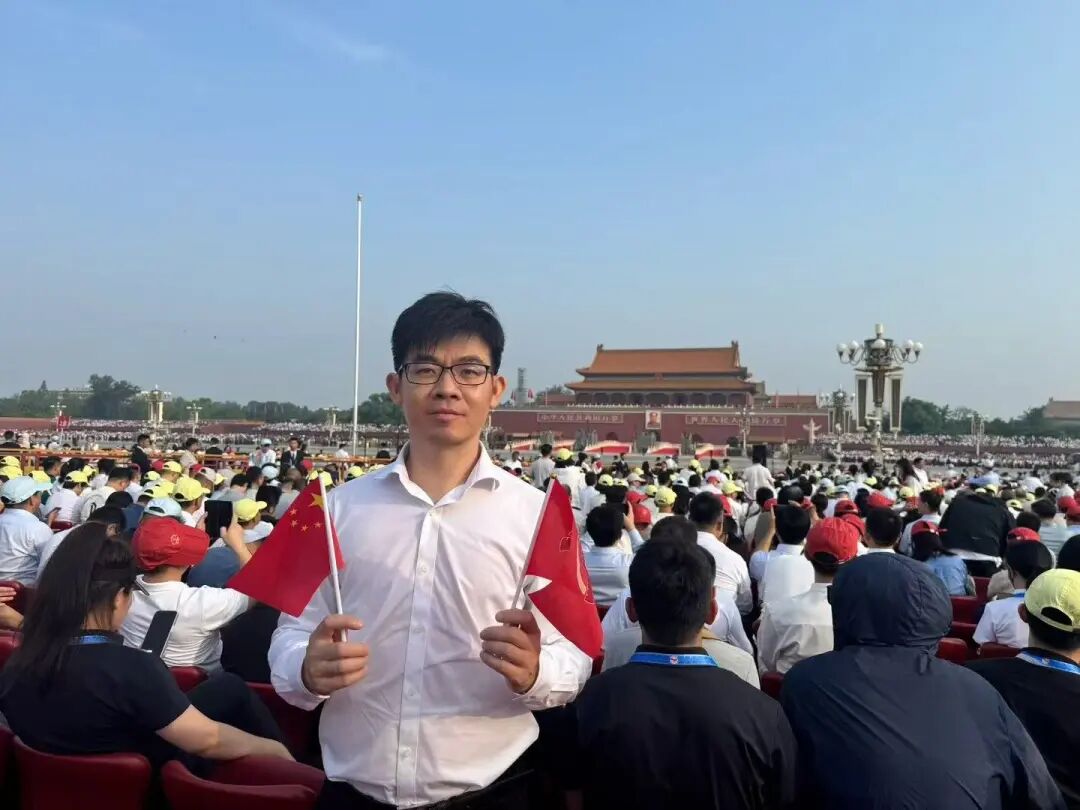
In 2025, I had the distinct honor of participating in China's September 3rd Military Parade as a corporate representative. It was a profound reminder that our generation must strive tirelessly for self-improvement and national strength!
In 2025, I was also honored to represent the carbon neutrality industry in the Forbes China 100 Most Influential Chinese Elite list. This recognition serves as a powerful testament to the fact that carbon neutrality and ESG have entered the social mainstream, gaining unprecedented attention and validation!
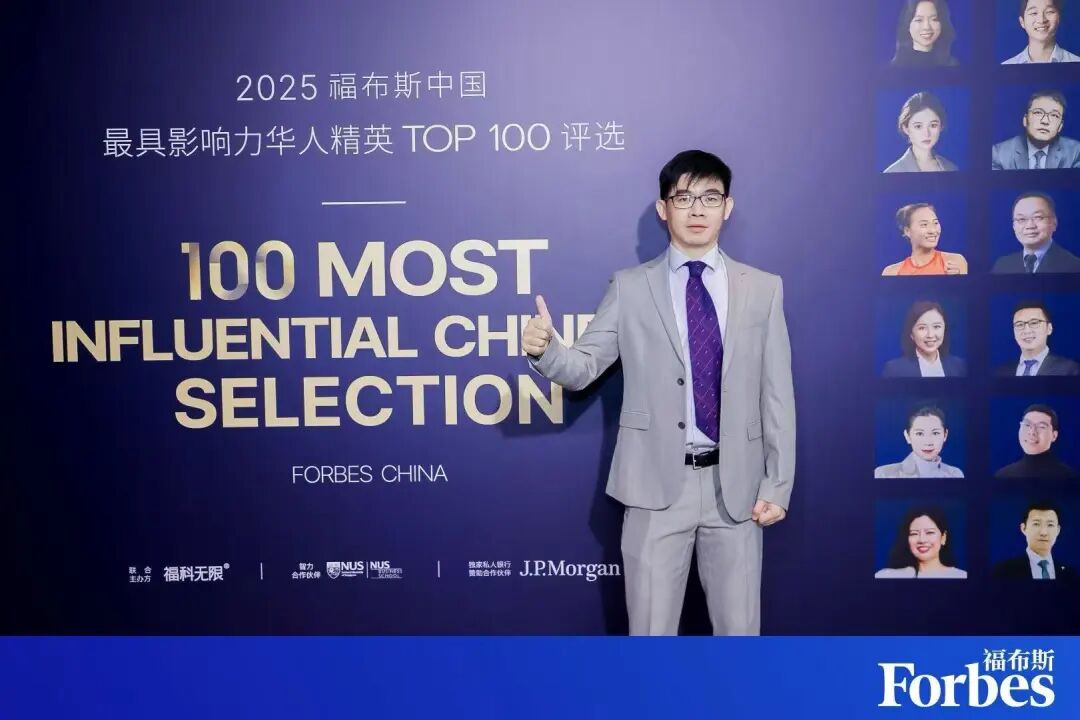
Regarding the future, we choose long-termism and a global perspective. We aim to position ourselves within a longer-term coordinate system while iterating at a high frequency, helping enterprises in China and across the globe march toward carbon neutrality!
2026 is not the climax, but rather the year when true infrastructure construction begins. The industry will become more rational, competition more intense, and the structure more defined.
Standing at the starting point of 2026 and looking ahead to the next decade, the endgame of carbon neutrality has become increasingly clear: True carbon neutrality is achieved when it is no longer a "topic" that needs deliberate emphasis, but a "default option" integrated into every link of production, life, and consumption—when carbon footprint becomes a basic product attribute, emission reduction becomes an intrinsic corporate demand, and low-carbon living becomes a conscious choice for humanity.
As the industry gradually cools down, the true builders will remain. When the hype recedes, the real infrastructure will emerge. 2026 is the pivotal year for carbon neutrality as it moves from the watershed into the deep-water zone, marking the beginning of value reconstruction. Challenges and opportunities coexist; difficulties and hope reside together. May we all meet the challenges of industry transformation with the "diamond-like" core strength of professionalism, while utilizing "graphite-like" flexible wisdom to connect the emission reduction forces of the entire industrial chain. Together, let us drive carbon neutrality from a goal to a reality and write the green chapter of this era!
I am grateful for this great era. 2026 promises to be magnificent and soul-stirring! I look forward to it immensely!


